
How to Search Criminal Dockets
For St. Bernard Parish felony cases and other district-court criminal matters, the place to start is the Thirty-Fourth Judicial District Court. It sits in Divisions A through E. The St. Bernard Parish Clerk of Court keeps the official court file. Clerk Randy S. Nunez heads that office. So a St. Bernard criminal docket search works in two layers. Pull the record itself from the Clerk first. Then, if you only need a current setting, check the public calendar or the division line. The District Attorney's calendar list helps with dates. But it is no substitute for a certified Clerk record of the court docket.
Gather a few things before you search. You will want the case number, the exact spelling from the case caption, and an approximate filing year. Case numbers on the public calendar follow a two-digit-year, hyphen, five-digit pattern. Sometimes a slash marks related counts. Treat that as a habit of the calendar, not a fixed rule. Copy every hyphen, zero, and slash straight from your citation or a prior court paper. One more wrinkle. A criminal case arising in St. Bernard may sit in a Justice of the Peace ward or in federal court. Each calls for a different record source.
- Identify whether the matter is in the 34th JDC, a Justice of the Peace ward, or federal court.
- Use the Clerk’s Cott eSearch account when a parish criminal index or minute image is needed.
- Use eClerks LA to locate qualifying statewide criminal minute-entry information.
- Check the District Attorney’s date list for a criminal setting, division, and time.
- Ask the Clerk for inspection, a copy, or certification when the official file is required.
St. Bernard Criminal Cott Search
Paid access is the route for detailed St. Bernard Parish criminal records. The Clerk runs the Cott eSearch portal, which needs an account and a prepaid subscription. Pricing on the public screen is straightforward. The criminal plan costs $20 for a day. A month runs $40, and a year costs $400. Criminal images run $1 each, and Criminal Minute entries cost $1 apiece. The search filters stay behind the login. No one can promise a specific name, date, or case-number search for the St. Bernard criminal docket.
Before subscribing, read the Cott terms screen. It spells out the account rules and record-use conditions for the parish criminal docket portal.
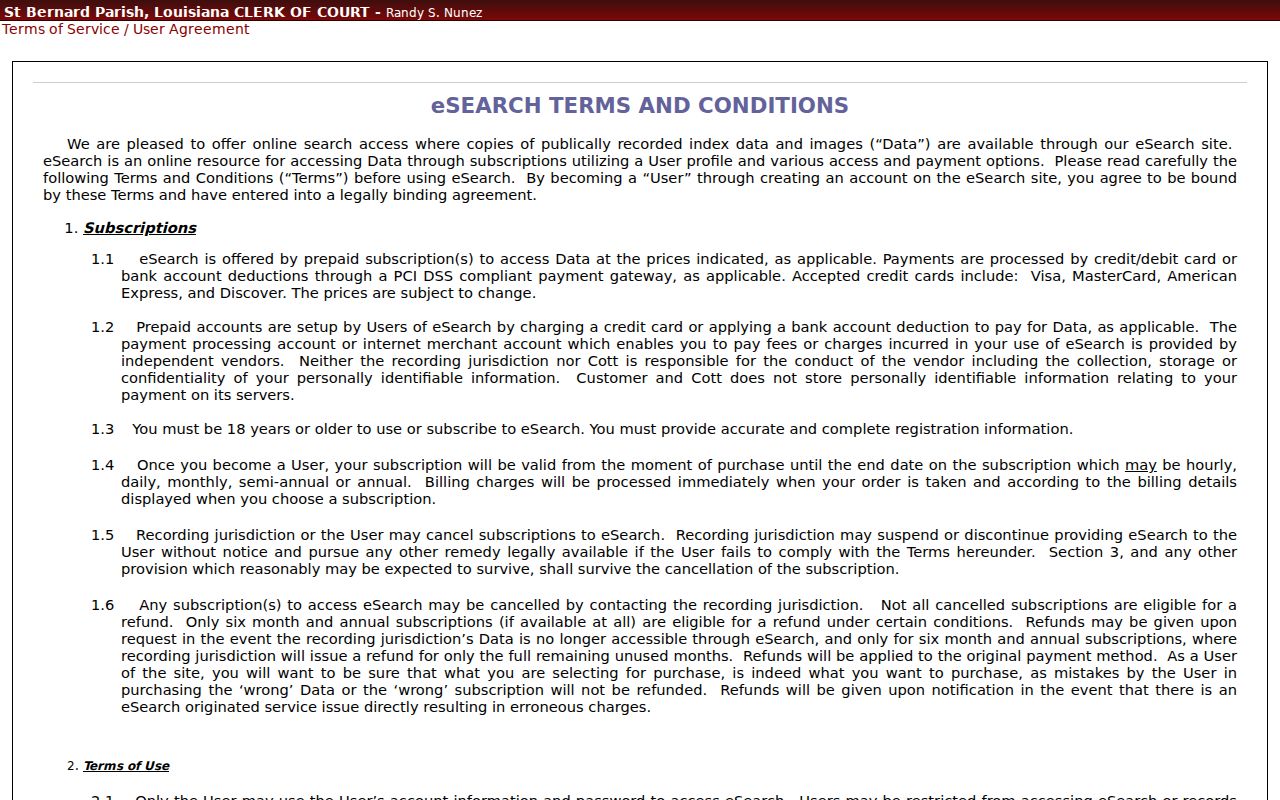
The terms also warn that online information can be incomplete or unverified. That warning matters. Check Certified Dates. For any older or unindexed St. Bernard criminal file, ask the Clerk directly. A portal image is only an access copy. It is never a certified court record of the criminal docket.
What a Criminal Docket Shows
Think of a St. Bernard criminal docket as a dated log of everything that happens in a case. The public District Attorney calendar gives you only a narrow slice, while Louisiana's qualifying minute-entry layer can describe more of the events. The exact Clerk codes and a full public Cott register are not published, so the fields below are a local, source-based inventory rather than a promise about every screen or every case in the court records.
| Case number | Clerk-assigned identifier. A public calendar pattern observed locally resembles 26-01234; preserve all punctuation and related-count notation. |
|---|---|
| Calendar setting | Date, division, time, and a heading such as Court or Felony Trial Week may appear on the DA’s public list. |
| Minute entries | Qualifying statewide entries can address arrest or summons, bail, charge changes, hearings, trial activity, and sentencing. |
| Case activity | Charging, arraignment, motions, orders, and appeal-related events may appear in the official record layer. |
| Disposition | A dismissal, plea result, acquittal, conviction, or sentence should be confirmed from the Clerk record or minute document. |
Resist the urge to guess at abbreviations. A docket entry may carry shorthand a reader has never seen. The accessible St. Bernard sources publish no local code sheet. Terms like a continuance or a disposition go undefined. When a code matters to a real case, the Clerk of Court can help. The Clerk can walk you through what that entry means and how it landed in the record.
St. Bernard Criminal Court Dates
The District Attorney posts a free Docket and Court Dates list. It even has a Type to Search box. Each card lists a date, a division, a time, and a case-number line. Tags include ordinary court or Felony Trial Week. For tracking down a St. Bernard criminal setting, it is the fastest tool around. Keep its limits in mind, though. It is a public calendar, not a certified court file. A listed date proves nothing about an earlier setting that may have been reset.
The calendar-entry page shows the heading format. That is the format the DA's office uses for a St. Bernard Parish criminal docket setting.
Check a current court date in this order. Start with the most recent filed notice or minute entry, then call the assigned division's administrative line, and finally the Clerk. A Felony Trial Week tag flags a block of trial-focused settings. It does not tell you that every listed case was tried or reached a verdict.
Stages on a Criminal Docket
A St. Bernard criminal docket usually begins with a charging event and builds from there. What follows is a chain of custody, appearance, motion, and setting entries. Each one is tied to a date. An arraignment is a hearing. There the accused hears the charge and is asked for a plea. It is not a conviction, and it should never be read as one. A motion is simply a request for a ruling. An order is the court's answer to that request. Read every entry alongside its date and any later minute entry.
Docket flow: Charge Filed › Custody or Bail › Arraignment › Motions and Status Settings › Plea or Trial › Disposition › Appeal or Other Post-Judgment Event
On a St. Bernard Parish criminal docket, the disposition line is where the final outcome lives. That line covers everything. It runs from a dismissal or nolle prosequi to an acquittal, conviction, plea resolution, or sentence. Whatever the label says, the underlying document or minute entry tells you more. A shortened docket entry can flatten real detail, so trust the court record itself.
St. Bernard Criminal Minute Entries
eClerks LA is the statewide LCRAA locator for parish clerks that take part. Under La. R.S. 13:5992, district clerks must give the public electronic access to minute entries or summaries. The mandate applies to qualifying criminal cases filed on or after January 1, 2020. Think of it as the docket's outline. The statute covers arrest or summons, bail, charges, motions, status conferences, trial or adjudication, guilt decisions, and sentence.
That layer is not a full image file. The statute asks for no other document images. Live criminal search fields require portal access. If you need a signed pleading, a full minute, or a certified copy, start at the statewide locator. From there, use the Clerk's Cott access or the Clerk counter.
Note: Traffic violations are excluded from this mandate. So a blank statewide criminal result says nothing about a traffic-court question in St. Bernard Parish.
St. Bernard Criminal Magistrate Duty
Committing-magistrate work in St. Bernard Parish means custody, bail, and warrants. It runs inside the 34th JDC rather than through a separate criminal court. Local rules give that job to the duty judge. The court publishes a monthly rotation naming which district division holds magistrate duty that month. Treat it as a schedule, not a record. The rotation is not the Clerk's case file. It is not a complete criminal docket for every matter.
The 34th JDC Magistrate page posts the St. Bernard Parish monthly rotation. It is used for this criminal-court function.
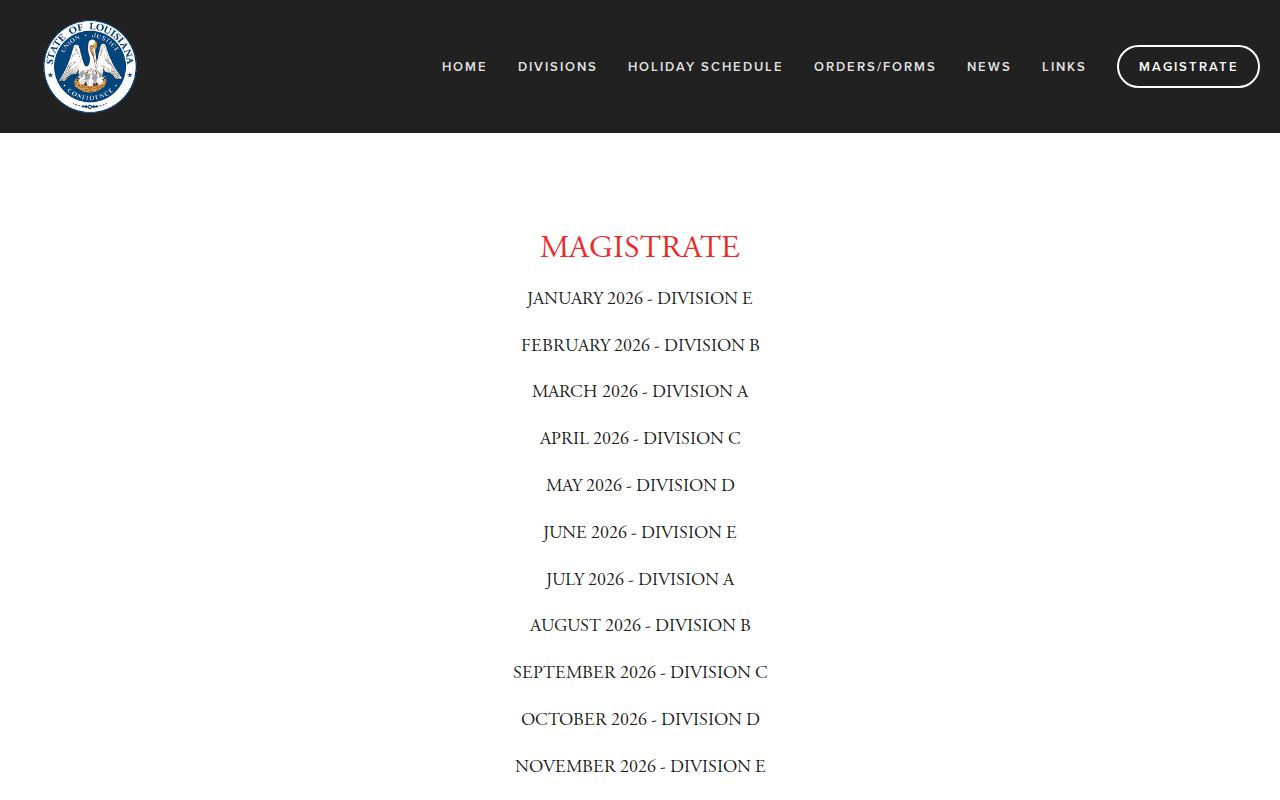
The District Attorney keeps a separate Magistrate Court and Bond Settings list. It can orient you to a dated bond setting. Confirm the live matter with the Clerk or the responsible division after that. Bail information can be thin. A court can change it later.
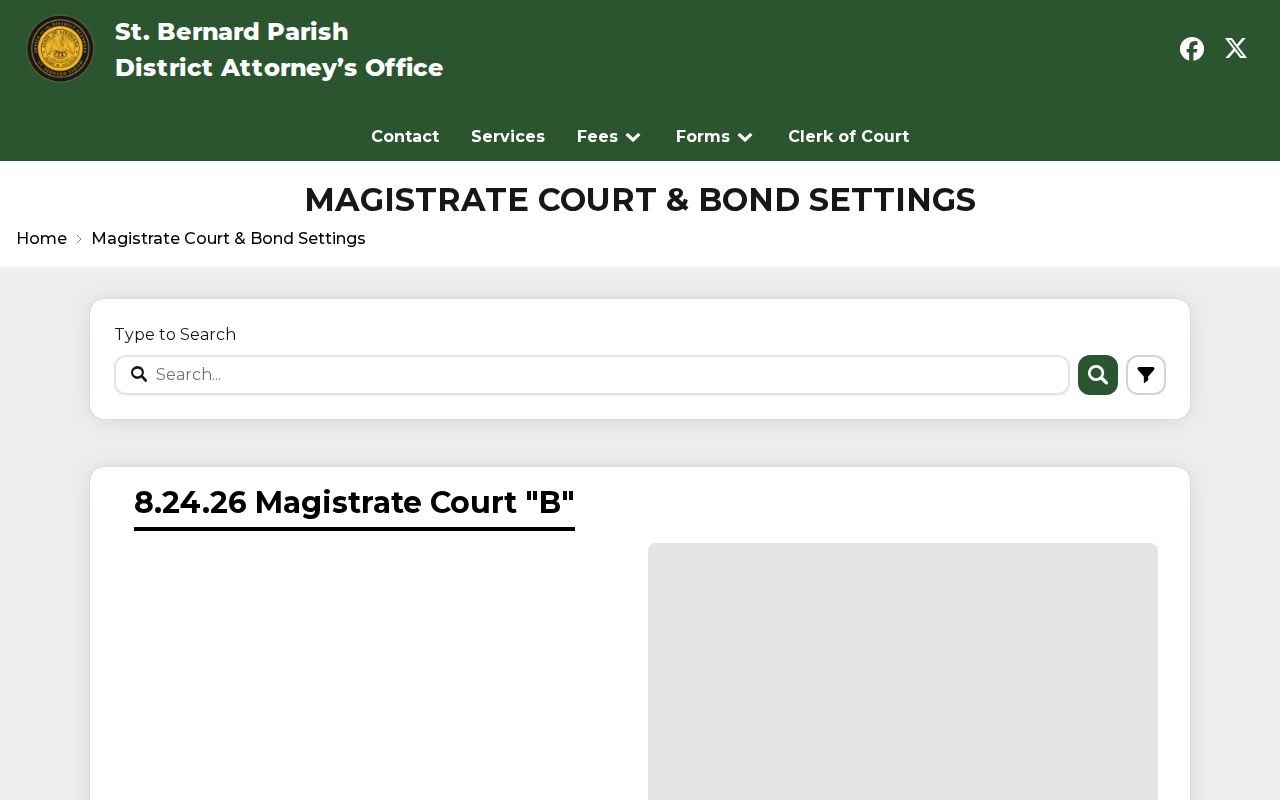
The dated Magistrate Court A and B cards are a public settings aid. They offer no complete criminal register, no charge history, and no certified proof of a bail decision in St. Bernard Parish.
Which Court Holds Criminal Dockets
The 34th JDC is the general-jurisdiction trial court for St. Bernard Parish. It handles felony and district-court criminal matters. Five elected divisions, A through E, sit within it. The parish Clerk holds the district-court file. Call the right division to confirm a current setting: A at (504) 278-4414, B at (504) 278-4420, C at (504) 278-4425, D at (504) 278-4433, or E at (504) 278-4417. The lines handle dates and resets. They do not certify records.
Justice of the Peace courts in Wards A through K keep their own lower-court records. They also keep their own contact channels. For a ward matter, begin with the official parish JP directory, not the 34th JDC Clerk. A federal criminal case belongs to the Eastern District of Louisiana's PACER and CM/ECF system. It never belongs to a St. Bernard parish portal.
St. Bernard Criminal Division Lines
Five divisions do not mean five separate criminal record keepers. The division offices are the right stop for a St. Bernard criminal hearing question. That matters most when a public calendar looks stale. A setting may have moved, too. The Clerk still keeps the case file. So do the minute entries, the pleadings, and the certified-copy authority. Keeping that line clear stops a calendar inquiry from being mistaken for a records request.
The official 34th JDC court page names the five divisions. Each division page gives administrative contact details. For an official record request, call the St. Bernard Parish Clerk at (504) 271-3434. Or write to P.O. Box 1746, Chalmette, LA 70044-1746. Include the case number, the record you want, and whether you need certification.
St. Bernard Criminal Traffic Limits
Traffic does not sit inside the statewide St. Bernard criminal minute-entry search. Louisiana's criminal-minute statute leaves traffic violations out of its mandate. Route a citation by the court named on it. State or parish traffic can involve the Clerk and the court record. A ward-level or local matter may have its own contact channel instead. St. Bernard Parish offers no unified online traffic-case portal.
Start with the citation itself. Then contact the issuing court, or the Clerk for a district-court file. The Sheriff's Traffic Division and other agencies have their own roles. None replaces the court docket custodian. This matters most when a criminal minute search returns nothing for a traffic citation.
St. Bernard Criminal Missing Cases
A missing result has several possible explanations in St. Bernard Parish. Recheck the exact case number, spelling, year, and punctuation. Then ask whether the matter is new. It may still sit in an indexing or verification window. It may sit in a JP ward instead. The matter could be federal, or traffic excluded from the LCRAA criminal layer. A gap in a St. Bernard criminal calendar proves nothing either way. The DA list is a settings publication. It is not a full register.
For an older file, ask the Clerk whether it is digitized, archived, on microfilm, or available only at the counter. For a current court date, try the DA calendar first, then the division line, then the Clerk. For a sealed, juvenile, or expunged matter, ask about the lawful access route rather than piecing together protected information from unrelated sources.
St. Bernard Criminal File Certification
A certified St. Bernard criminal file comes from one office only: the Clerk. The District Attorney posts a St. Bernard criminal calendar. A division office will confirm a hearing date over the phone. Neither of those produces a certified copy. Louisiana law puts that power with the Clerk of Court. Ask for the case number first. Then say what you need. That may be a docket or minute entries, a judgment, an order, or another filed record. The Clerk sets no posted certification fee or mail turnaround. Call before you rely on a number.
A Cott image helps you find and read an available record. It is not a certified copy on its own. That gap matters when a formal court purpose demands an authenticated document. Before mailing anything, call the Clerk. Confirm the charge and the accepted payment method. Ask about any limits tied to a sealed or restricted file.
Public Access and Sealed Criminal Dockets
La. C.C.P. art. 251 names the Clerk as legal custodian. It generally allows inspection, copying, photographing, memoranda, and certified copies during required office hours. Another law can limit access. For an official file, an older record, or a certified copy, the Clerk counter at 1101 W. St. Bernard Highway is the fallback that counts. The Clerk publishes no current plain-copy, certified-copy, search, or mail-processing fees. Confirm those amounts before you send payment.
Access has real limits, though. Juvenile records stay confidential under La. Ch.C. art. 412. Expunged records fall under La. C.C.P. art. 973, which makes an expunged arrest or conviction confidential and no longer public, apart from limited statutory exceptions. Sealed material, child-protection files, and protected identifiers can also be restricted. The Clerk will walk you through the request path without revealing protected content.
Key Rules:
La. C.C.P. art. 251 identifies the Clerk as custodian and supports inspection, copies, and certified copies when access is allowed.
La. R.S. 13:5992 provides the qualifying criminal minute-entry program but excludes traffic and does not require full document images.
La. R.S. 44:1 broadly defines public records while leaving statutory and constitutional exceptions in place.